
Did You See A Bird?
What color was it? How big was it? Let’s get started birding and you might be surprised how much wonder is waiting just outside your door. Birding is one of the fastest growing hobbies in the world!
Are you ready to start birding?
Birding is one of the fastest growing hobbies in the world for good reason – it is low cost, can be done anywhere at any time, brings us closer to nature, and benefits both our physical and mental health.
It can seem daunting at first. We’ve all had that experience early in our birding career encountering an advanced birder in a local park with an expensive pair of binoculars and a giant camera lens spending hours at a single spot to try and identify a small, flitting bird brown bird that is only identifiable from the other, small, flitting brown bird by a thin wing bar. Or perhaps you’ve been on a bird walk with other birders who can identify every single song or call they hear in all seasons.
The beauty of birding is that it is for everyone – regardless of experience level, gender, age, race, or ability. In fact, the term ‘birding’ has largely replaced the term ‘birdwatching’ because it is more inclusive.
Whether you have goals to have a bird life list of 10,000 species or just enjoy learning a few species in your local park, here are some tips on getting started.
Learn the basics of visual bird identification
Field guides, whether you have a paper copy you bring in a backpack or a mobile version you can put in your pocket, having a resource that provides basic identification of common birds in your area is essential. Spend some time around your house learning about the most common birds you see – Northern Cardinals, Northern Mockingbirds, Carolina Wrens, Carolina Chickadees, and Tufted Titmice are some of our common backyard residents in Georgia. Flip through your field guide to start seeing patterns with similar groups of birds. Things like size, shape, bill size, and of course, color are going to be some of the first things you will notice when identifying birds. Another key part of visual bird identification is behavior. Was the bird pecking on a dead tree, flitting quickly from bush to bush, soaring overhead, or flying quickly across the sky?
Over time, you will start to feel the ‘gestalt’ of a bird – its overall impression stemming from its shape, size, movement, behavior. You’ll be able to key in and separate a warbler from a vireo or a plover from a sandpiper.

Binoculars can feel overwhelming at first. The numbers on them are confusing, prices vary widely, and more magnification doesn’t always mean a better viewing experience.
Read Our Binoculars GuideBirding by habitat
One of the key ways to identify birds is by narrowing down what habitat type you are in. If you’re in a forest, you’re not likely to find a shorebird, and conversely, if you’re on a beach, you’re not likely to see a flycatcher in the sand. Some birds are habitat specialists, meaning they only occur in a particular habitat type, whereas others are generalists and may use several different types of habitats.
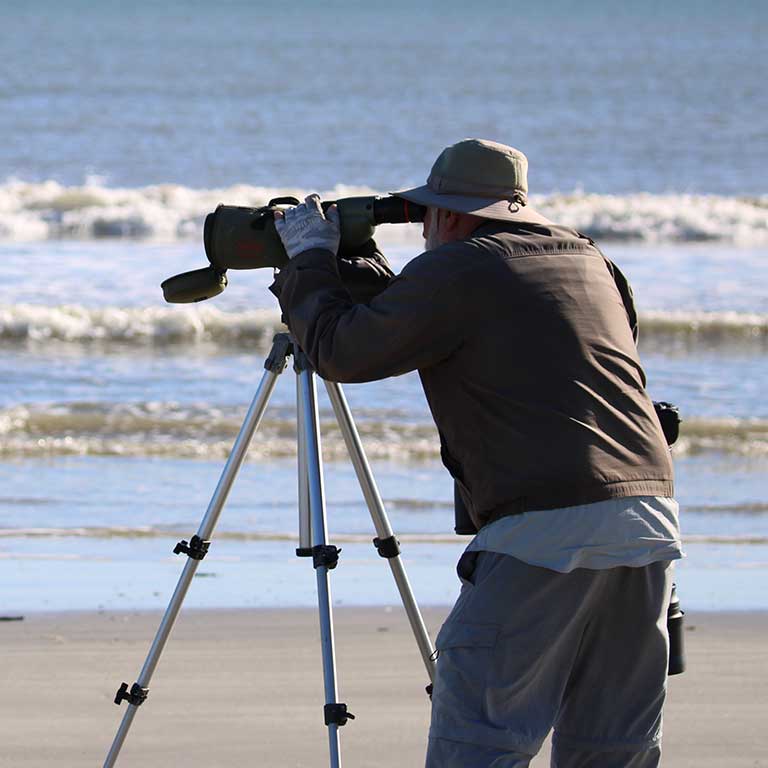
Different habitats will also require different styles of birding. For very open habitats, including wetlands, grasslands, and beaches, you might consider bringing a spotting scope to increase your chances of seeing far away birds. In forested areas, your chances of seeing birds from a very far distance are much less, therefore, just a pair of binoculars will do the trick.
Start learning calls and songs
One thing you will notice very quickly when you start birding is that you will hear a lot more than you will see.
In fact, upwards of 70% of birding is done by ear.
That means you have a much greater chance of identifying birds if you learn their call and song. Vocal identification can be more challenging than visual identification for most because pitch, tones, and frequencies are more difficult to remember than physical traits. Therefore, it’s important to not overwhelm yourself and commit to learning just a few at a time. There are very helpful apps like Cornell’s Merlin Bird ID that can help identify songs and calls in the field.

Try to become more in tune with your surroundings
Birding can be hugely beneficial for our mental states, as it requires us to slow down and take in nature. Use birding as a mindfulness practice and key in on your senses. Be sure to move slowly, watch carefully for slight movements, and listen quietly for sounds in the distance. It is easy to miss birds, especially in seasons when they are quieter and less showy.
Bring a camera
Using a camera with a zoom feature can be very beneficial for documenting the birds you see and learning to identify birds by comparing your photos with field guides. You can upload photos to the Merlin Bird ID app for identification, and there are several Facebook groups that can also help with tricky identifications. If you do find an uncommon or rare bird, it also provides documentation.
Go on a guided birdwalk
Having the help of a more experienced birder in the field is invaluable. A good field trip leader will take the time to show everyone in the group small details and nuances that you may have overlooked if you were alone and give more context on where to look, what habitats bring what birds at different times of the year, and tips for memorization. Birding in a group setting also helps to get more eyes on birds, increasing your chances of seeing things.
Guided Birdwalks are also a great way to build community and meet new people locally who share your interests. Birds Georgia offers field trips geared towards all levels of birders throughout the year and throughout the state. View our calendar of field trips.
Local Audubon chapters also lead trips regionally throughout the year:
Beginning Birding
In conclusion, birding is a great hobby that is accessible to all. Focus on these identifying features when you are just getting started with birding:
- Size, Shape & Plumage: Compare the bird to something familiar, like a heron or a cardinal, to get an idea of its size. Look at the shape of the beak, tail, and wings. Notice the colors on different parts of the bird, like the head, chest, and wings. Look for any special markings like stripes, spots, or patches.
- Behavior: Pay attention to how the bird moves. Is it hopping on the ground, climbing a tree, or soaring in the sky?
- Habitat: Learn how certain birds are closely associated with certain habitats. For example: Pine Warblers and nuthatches usually associate with pine trees, and most of our shorebirds are found on the coast or edges of a wetland.
- Sounds: Birds have unique calls and songs. Listening to these can help you identify them even if you can’t see them clearly. For example, the Brown-headed Nuthatch sounds distinctly like a squeaky toy! Associating common songs with mnemonics can also be helpful, like the Tufted Titmouse’s “peter-peter-peter” call.
Start Your Adventure!
We hope these tips help you as you start your birding journey and look forward to seeing you on the Georgia Birding Trail!