By Steve Phenicie, Birds Georgia Member
Sometimes the highlight of a bird walk isn’t the birds. After a recent day of nothing-to-write-home-about birding at Blue Heron Nature Preserve, I turned to go back to my car and found my path blocked by a none-too-eager-to-move Copperhead.
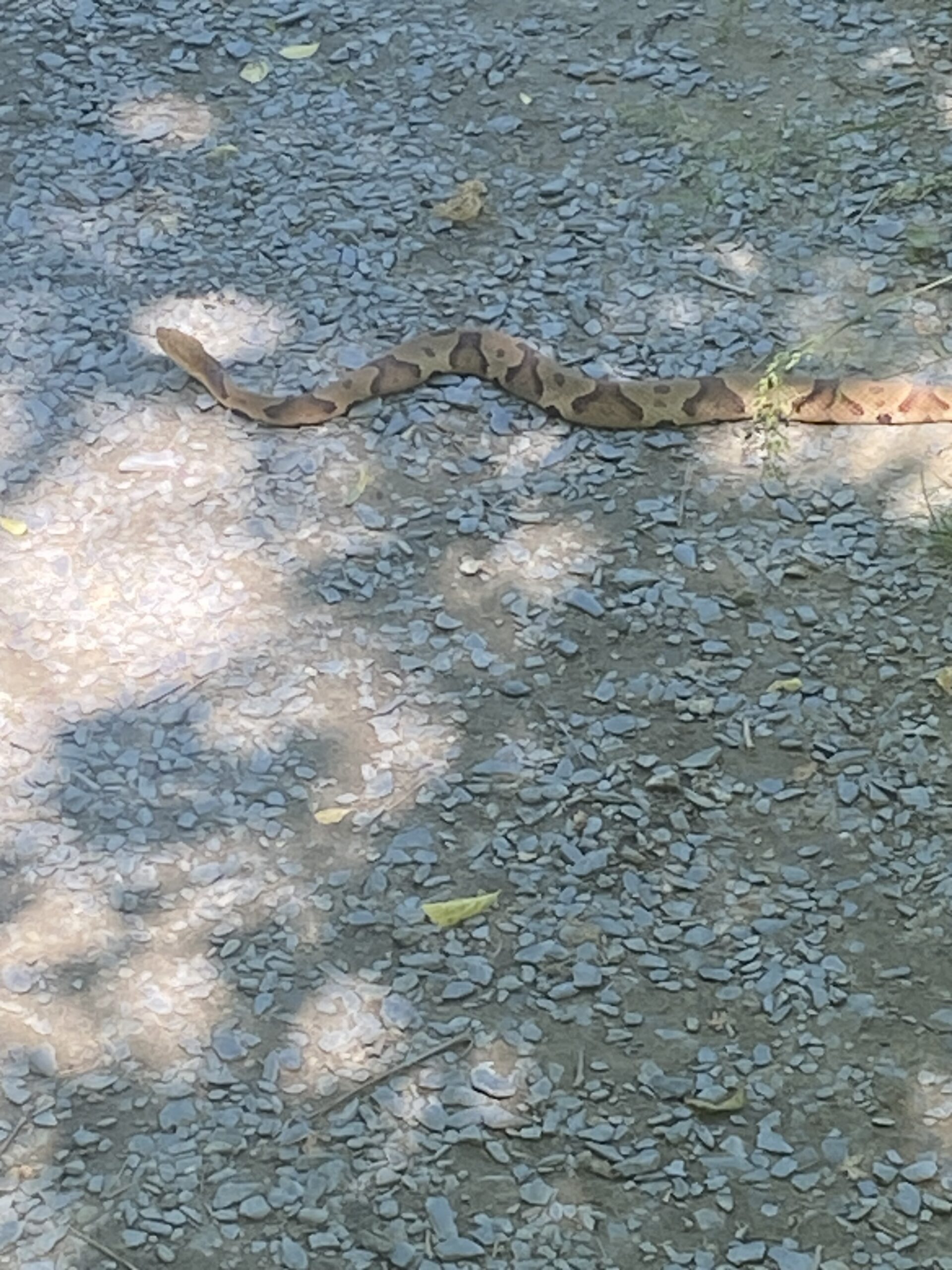
Because of the wet terrain, going around him was impractical. I could have retreated, made my way out to the street and gotten out that way, but there was a principle involved! After all, did he think he owned the place? Finally, after about 10 minutes, he moved on and I got back to my car.
Despite my lackluster day of birding, others have better luck. As of late April, eBird listed 62 species that had been recorded so far this year at the preserve. All-time, the total is 143, although some of them have not been seen in more than decade. A few notable ones seen this year: Ring-billed Gull, Pine Siskin, Wood Duck, and Fox Sparrow. A sample from the last few years: American Pipit, American Coot, Northern Waterthrush, Eurasian Collared-Dove, Yellow-billed Cuckoo, Blue Grosbeak, Solitary Sandpiper, and Ovenbird. The preserve’s namesake, the Great Blue Heron, doesn’t seem to show up as much as you might expect: Nobody had reported one since January.
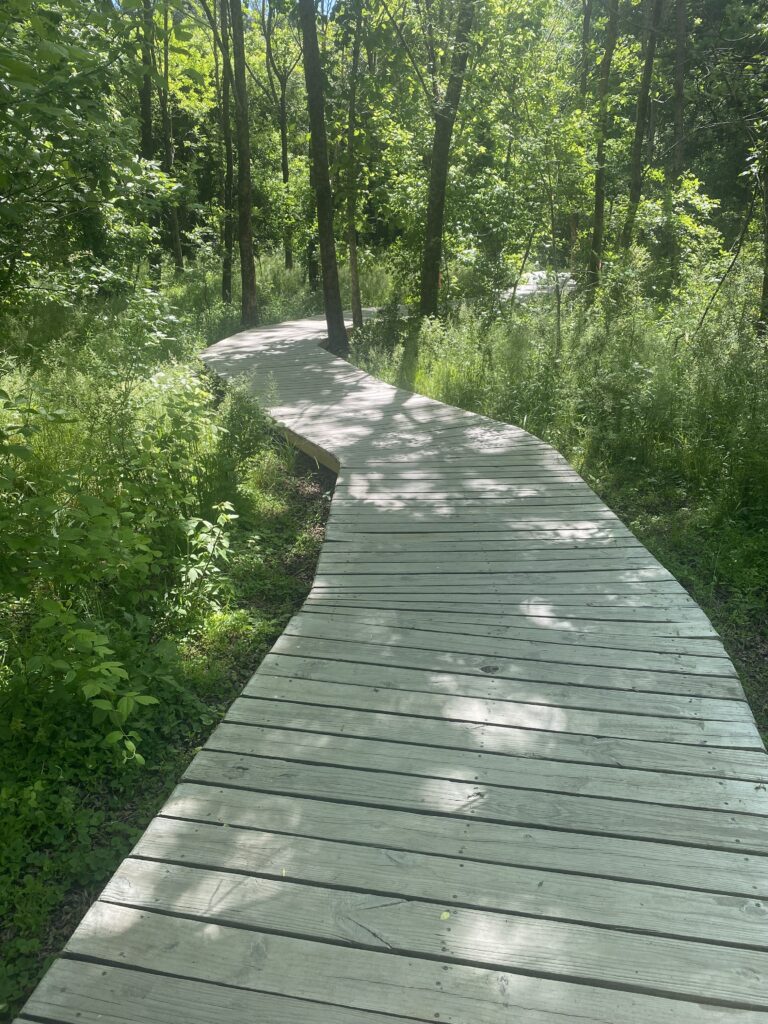
The preserve covers 30 acres but is no wider than a few hundred feet even at its widest point. The city-owned facility is located at 4055 Roswell Road in Buckhead, not far inside the Atlanta city limits. Trails, which are either boardwalks or unpaved paths along Nancy and Mill creeks, are free, as is parking. As in most any city park, loose dogs are a no-no, but some owners think there’s no good reason for that rule. (Isn’t the presence of Copperheads a good reason?)
The preserve’s web site lists four distinct habitats.
The Meadows habitat is located along the Painted Turtle Trail near the main building and in the Land O Lakes area in the southernmost part of the preserve. There you will see such plants as Broom Sedge, Purple Coneflower, Black-eyed Susan, and Goldenrod. Animals present include the Eastern Fence Lizard, the Southern Black Racer, Bumblebees, and the Painted Lady and Black Swallowtail butterflies.
In the Woodlands area along Nancy Creek and the Confluence Trail in the southern part of the preserve, there’s vegetation such as Bigleaf and Southern magnolias, Loblolly Pine, Trumpet Vine, and Beautyberry. Animals include Raccoon, Eastern Chipmunk, Corn Snake, and Five-Lined Skink.
Wetlands habitats run throughout the preserve, with the Emma Wetlands often considered the best area to bird. Typical plants there are the Common Blue Violet, Yellow Birch, Tulip Poplar, Sensitive Fern, and Butterweed. You might see Garter
Snakes, an Eastern Box Turtle, White-tailed Deer, Eastern Cottontails, or even a Coyote.
Riparian habitats run along the two creeks and support vegetation such as Tulip Poplar, River Cane, Cinnamon and Lady ferns, and American Hornbeam. Animals possible here include River Otters, Snapping Turtles, Bullfrogs, Bluegills, and the Great Blue Skimmer Dragonfly.
Blue Heron Nature Preserve includes a community garden, a native plant education garden, a wildlife observation blind, picnic tables, a field research center, and a little free library. There are no public restrooms. There’s also a main building where classes are offered and nature-themed art exhibitions and camps are held, but its future is up in the air right now.
Originally the city was scheduled to demolish the building this summer, but Blue Heron asked for a reprieve so the feasibility of remodeling it could be studied.
Rainie B. Jueschke, Blue Heron Nature Preserve’s executive director, says: “The future of the facility is tied to a forthcoming City of Atlanta process to develop a new nature center. As we understand it, the city plans to issue an RFP (request for proposal), and the selected partner will ultimately determine whether the existing building is renovated or replaced.”
She says that Blue Heron Nature Preserve is currently authorized to continue its programs there through at least Aug. 31, pending the city’s next steps. This means business as usual for the foreseeable future – trails and natural areas remain open, and education programs, camps, and community offerings will continue.
Birds Georgia, when it was known as the Atlanta Audubon Society, was located at the Blue Heron until moving to its present quarters at 825 Warner St. in southwest Atlanta a few years ago.